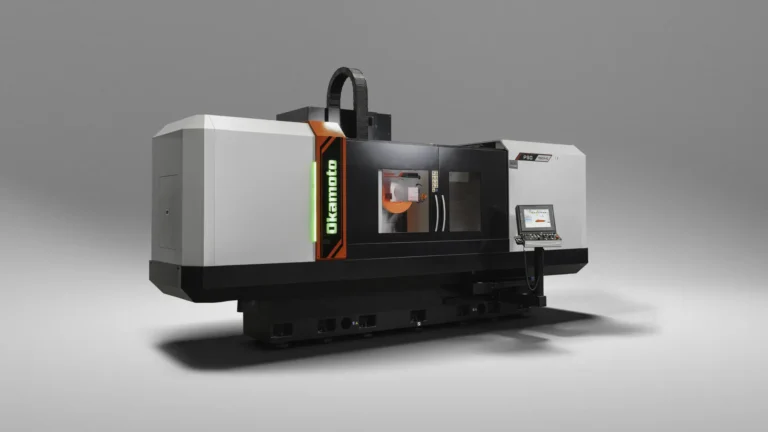
The new PSG CAiQ series surface grinding machines complement the successful ACC-CAiQ machine series.
Whether in the aerospace, automotive, mechanical engineering, or medical and electronics industries – superior surface finishes in component grinding, as well as speed, sustainability, and cost-effectiveness, are crucial factors that users demand. Grinding machine manufacturer Okamoto provides industry with customized grinding solutions: These advanced machine concepts enable state-of-the-art manufacturing technologies and unlock the potential of innovative abrasives to produce superior surface finishes with the highest precision and at a competitive price. The new PSG CAiQ series surface grinding machines are one example, complementing the successful ACC-CAiQ machine series.

The ACC-CAiQ grinding machine series has been expanded with two new sizes: the PSG-126CAiQ with a longitudinal x transverse travel of 1,200 x 600 mm and the PSG-157CAiQ with 1,500 x 700 mm. These new, larger models benefit from an extremely robust, heavy-duty machine bed with a new traveling column design. The wider cross slides further increase the machine’s rigidity and strength. From the 1.2 m size upwards, the machines are equipped with a reinforced grinding head, a 15 kW spindle motor, and a 510 mm diameter grinding wheel. Despite the longer table stroke, the cycle time is reduced thanks to a low-maintenance ball screw table drive with a feed rate of up to 40 m/min.
Thomas Loscher, Technical Manager at Okamoto: “The ball bearing table drive enables not only highly precise positioning of the grinding table but also low-friction and very fast movement. This results in shorter cycle times, as traverse speeds can be increased. The reduced friction also helps to optimize energy consumption and increase efficiency. Ultimately, the ball bearings contribute to the precise repeatability of table movements, which is crucial for consistent results and dimensional accuracy.”
All machines in the CAiQ series feature an extremely rigid cast iron bed with fully supported guideways, guaranteeing maximum stability and accuracy. The hand-scraped double-V table guideway ensures perfect distribution of the lubricating oil film and guarantees a flat surface and straight table movement. Thomas Loscher: “Our technicians have extensive experience and craftsmanship in scraping the guideways to sub-micrometer precision. This ensures that the grinding machines with hand-scraped V-guideways are optimally adjusted to achieve the best results.” The two-tone, ergonomic design of the fully enclosed machine housing with a locking sliding door allows for the use of modern, high-volume, high-pressure coolant systems, increasing productivity while keeping the workshop environment clean.
iQ Thinks Ahead
Programming complex tasks in precision grinding often depends heavily on the operator’s experience. The development of the Okamoto iQ touchscreen control and its user-friendly software, combined with the inherent mechanical accuracy of the column motion design, enables less experienced operators to use the machine with maximum efficiency. The Fanuc touchscreen control with Okamoto iQ functions has been further developed and can be set up even faster and more easily in both production and toolmaking environments. It offers a larger, high-resolution touchscreen with sharper graphics and very short response times.
The Fanuc iQ touchscreen control with Okamoto iQ functions has been further developed and is even faster and easier to set up in both production and toolmaking environments. Thomas Loscher: “The graphical touchscreen user interface of the iQ surface grinding machines is undoubtedly one of the best control systems on the market. Graphical representations of common, user-friendly grinding cycles and wheel shapes can be quickly set up directly on the touchscreen using the iQ function. Among other things, the iQ function can automatically suggest the optimal grinding conditions simply by entering the grit size of the grinding wheel. Ultimately, thanks to the fast setup and programming time, the user can quickly and efficiently produce the first part, whether for small batches or in automated production.”